
Updated: 2026 Technical Guide · By Sailwin Mold
Beryllium Copper Inserts in Blow Molds: Thermal Conductivity & Tooling Longevity
In high-speed extrusion blow molding (EBM) and PET stretch blow molding, the cooling phase represents over 60% of total machine cycle time. Standard tool steels (like P20 or 420 stainless) have low thermal conductivity, creating localized heat traps in thick container sections—such as bottom pinch-off seams, deep handle recesses, and neck domes. These hot spots cause bottle warping, delayed demolding, and high reject rates.
Sailwin Mold engineers high-performance blow molds utilizing premium beryllium copper (CuBe alloy / MoldMAX) inserts strategically positioned in critical thermal choke points. Offering thermal conductivity up to 4 times higher than steel ($135\text{ W}/(\text{m}\cdot\text{K})$ vs $29\text{ W}/(\text{m}\cdot\text{K})$) while maintaining high structural hardness (HRC 38–42), our hybrid tooling slashes cooling cycle times by 20% to 35%.
This technical engineering manual examines copper-beryllium metallurgical properties, galvanic corrosion prevention, CNC micro-milling parameters, and cycle time reduction thermodynamics.
Key Engineering Takeaways
- 4x Faster Thermal Dissipation: Beryllium copper conducts heat away from molten plastic four times faster than tool steel, rapidly solidifying thick container pinch-offs and corners.
- Up to 30% Cycle Time Reduction: Eliminating localized mold hot spots allows earlier container demolding, boosting hourly machine output from 600 to over 800 bottles per hour on single-cavity lines.
- Superior Pinch-Off Edge Wear Resistance (HRC 40): Vacuum-aged CuBe alloys provide high compressive yield strength (1,100 MPa), resisting edge peening and rounding during millions of high-tonnage mold clamping cycles.
Consulting on custom molds or tooling configurations?
Send us your 2D/3D container drawings (STEP/IGS/DWG) for a complimentary DFM moldflow analysis.
1. Thermal and Mechanical Comparison: Beryllium Copper vs. Tool Steels
Thermodynamic and metallurgical specifications comparing mold insert materials:
| Material Property | Beryllium Copper (CuBe MoldMAX) | P20 Tool Steel | Aircraft Aluminum 7075-T6 |
|---|---|---|---|
| Thermal Conductivity | $135\text{ W}/(\text{m}\cdot\text{K})$ (Superior) | $29\text{ W}/(\text{m}\cdot\text{K})$ (Low) | $130\text{ W}/(\text{m}\cdot\text{K})$ (High) |
| Hardness (Heat Treated) | HRC 38 – 42 | HRC 30 – 34 | HB 150 (Soft, easily dented) |
| Yield Strength | 1,100 MPa | 850 MPa | 500 MPa |
| Pinch-Off Wear Life | 3,000,000+ Cycles | 1,500,000 Cycles | < 200,000 Cycles (Requires steel inserts) |
| Corrosion Resistance | High (Non-rusting copper alloy) | Moderate (Prone to oxidation in water channels) | Moderate (Susceptible to alkaline pitting) |
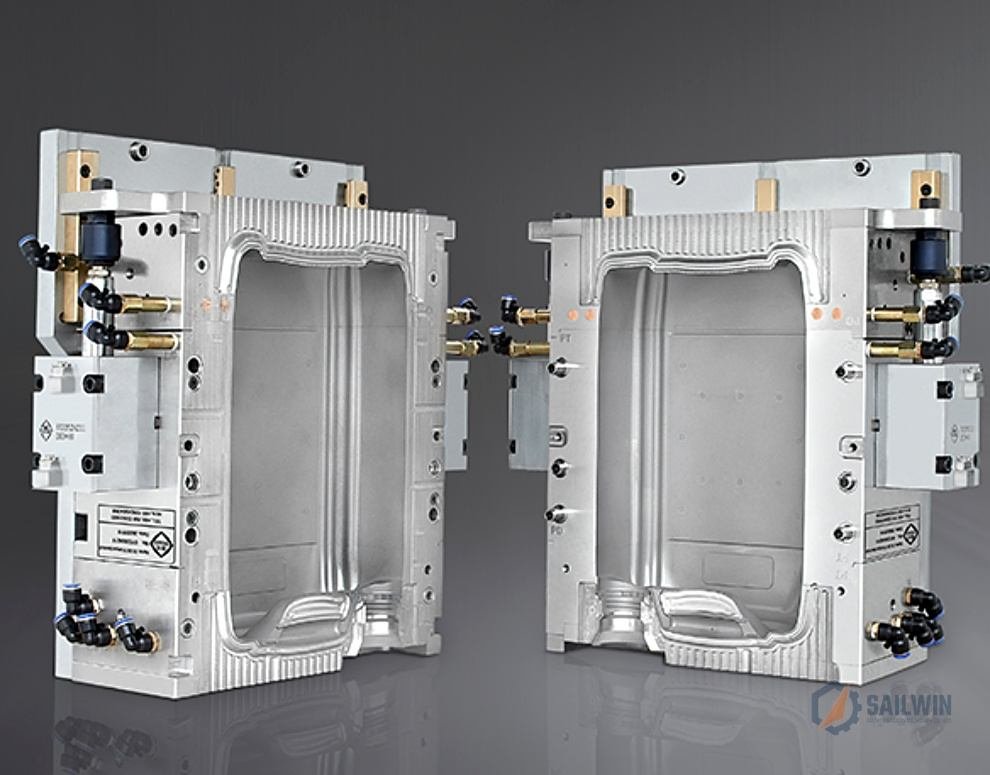
Figure 1: Extrusion blow mold cavity halves showing golden beryllium copper cooling inserts along handle and base seams.
2. Strategic Placement of CuBe Inserts in Blow Mold Cavities
- Bottom Tail Pinch-Off Seams: The thickest plastic mass in an extrusion blow mold pinch-off container is the squashed parison tail at the base. Installing CuBe pinch blocks solidifies this thick weld line in seconds, preventing post-demolding base sag.
- Deep Handle Grip Cores: In detergent and chemical jugs with hollow handles, cooling water cannot reach the tight handle cleft. CuBe inserts draw heat away rapidly into adjacent cooling channels via conduction.
- PET Bottle Base Petaloid Inserts: In high-pressure carbonated soft drink (CSD) PET bottle blow molds, CuBe petaloid tips chill the thick amorphous gate area, preventing crystallization haziness and base stress cracking.

Figure 2: Precision-machined 2-cavity jerrycan blow mold with integral beryllium copper thermal management inserts.
3. Tooling Case Study: Detergent Bottle Producer Cuts Cycle Time by 4.2 Seconds with Beryllium Copper Tooling
Household Chemicals Bottler (Monterrey, Mexico) upgraded tooling specifications to Sailwin precision molds, cutting cycle times and eliminating structural part defects.
- Blowing 4-liter HDPE liquid detergent jugs with large hollow handles on a shuttle EBM machine.
- Cycle time was stuck at 22.5 seconds because the thick handle pinch-off remained soft, causing handle tearing during automated deflashing.
- Attempting to lower cycle time caused 12% handle leaker defects on warehouse pallets.
- Upgraded mold tooling to Sailwin 7075 aluminum cavity bodies with MoldMAX beryllium copper pinch inserts.
- Engineered direct-contact conformal water passages behind the copper pinch blocks.
- Recalibrated deflashing timing to synchronize with faster part cooling.
- Cooling time reduced by 4.2 seconds, bringing total cycle time down from 22.5s to 18.3s (22.9% output increase).
- Handle deflashing tears and leakers dropped from 12% to less than 0.1%.
- Increased daily production by 1,800 jugs per machine, generating $86,000 in additional annual packaging revenue.
Data source: Sailwin Customer Field Case Log #MEX-COPPER-2025. Equipment: 4L Detergent EBM Mold.
4. CNC Machining & Maintenance Guidelines for Beryllium Copper
Tooling fabrication and safety standards for machining copper-beryllium alloys:
| Fabrication Parameter | Recommended Engineering Setting | Tooling Tool / Procedure | Safety & Operational Rule |
|---|---|---|---|
| CNC Cutting Speed ($V_c$) | 120 – 180 m/min | Carbide end mills with TiAlN coating | Flood wet machining mandatory; never dry machine |
| Feed per Tooth ($f_z$) | 0.05 – 0.12 mm/tooth | Rigid short-overhang milling tool holders | Prevents work hardening and tool chatter |
| EDM Wire Cut / Sinker | Standard copper spark settings | Deionized water dielectric | Electrolyte flushing removes ablated copper particles |
| Galvanic Isolation | Anodized aluminum or nickel plating | Isolating gasket or O-ring separation | Prevents galvanic corrosion between copper and aluminum |
Frequently Asked Questions
Have specific mold requirements or technical drawings?
Connect directly with Sailwin’s tooling engineering department on WhatsApp for fast technical review.
5. Summary: High-Precision Mold Engineering
Achieving multi-million cycle tooling longevity and sub-10 second cycle times requires balancing mold metallurgy, high-speed conformal cooling channels, and micron-accurate cavity alignment. Sailwin Mold delivers turnkey blow molds, PET preform tooling, beverage cap molds, and cap automation machinery backed by global commissioning support.
- Beryllium copper inserts deliver 4x faster thermal conductivity, slashing blow molding cycle times by up to 30%.
- High hardness (HRC 40) ensures pinch-off edges resist rounding across millions of production cycles.
- Partner with Sailwin Mold for hybrid aluminum-copper and steel-copper blow molds engineered for high-yield container manufacturing.
SAILWIN MOLD · PRECISION TOOLING SOLUTIONS
Ready to Engineer Your High-Yield Plastic Mold?
Send us your container drawings (STEP/IGS/CAD) or physical samples. Our engineering department will perform DFM moldflow simulation, calculate cycle times, and prepare a comprehensive mold proposal within 24 hours.
Explore Precision Tooling & Machinery Solutions:
• extrusion blow molds – Industrial extrusion blow molds (EBM) collection.
• jerry can mold – 10L-30L chemical jerrycan extrusion blow molds.
• blow molds – High-speed PET stretch bottle blow molds collection.
• blow mold tooling – Automated deflashing bottle extrusion blow molds.
• Need custom tooling advice? Contact our tooling engineers for an individual container design evaluation.