
Updated: 2026 Technical Guide · By Sailwin Mold
Extrusion Blow Mold Pinch-Off Design: Angles, Lands & Welded Seam Strength
In extrusion blow molding (EBM) of HDPE bottles, detergent jugs, and chemical jerrycans, the pinch-off zone is the most critical mechanical feature on the mold. An unoptimized pinch-off creates two catastrophic extremes: if the pinch knife is too sharp, it cuts through the molten parison, creating thin, brittle seams that rupture on drop testing; if it is too blunt, excess flash remains attached, jamming automated deflashers and leaving razor-sharp burrs on container bases.
Sailwin Mold engineers high-precision extrusion blow molds incorporating mathematically optimized pinch-off geometry across bottle bottoms, handle inserts, and neck domes. Featuring dual-angle relief tapers (30° primary / 45° secondary), precision land widths (0.25mm to 0.40mm), and generous flash relief pockets, our tooling ensures 100% airtight molecular weld strength with effortless flash separation.
This technical tooling manual details parison compression thermodynamics, flash pocket volume sizing, beryllium copper pinch insert integration, and drop-impact structural reinforcement.
Key Engineering Takeaways
- Optimal Pinch-Off Land Width (0.25mm – 0.40mm): Balancing land thickness maintains molten polymer hydrostatic pressure inside the cavity while allowing clean flash separation during automated trimming.
- Dual-Angle Relief Geometry ($30^\circ / 45^\circ$): A 30-degree primary angle forces plastic inward to forge a dense welded seam, while a 45-degree secondary taper channels excess flash outward into relief pockets without jamming platens.
- Beryllium Copper (CuBe) Insert Longevity: Installing vacuum-hardened beryllium copper pinch-off blocks along high-wear bottom parting lines accelerates cooling by 4x and prevents steel edge rounding across millions of cycles.
Consulting on custom molds or tooling configurations?
Send us your 2D/3D container drawings (STEP/IGS/DWG) for a complimentary DFM moldflow analysis.
1. Pinch-Off Kinematics: Angles, Lands, and Flash Relief
Critical dimensional cross-section of high-yield extrusion blow mold pinch-off tooling:
| Pinch-Off Geometric Zone | Nominal Dimension Setting | Engineering Function | Defect If Out of Tolerance |
|---|---|---|---|
| Pinch Land Width ($W$) | 0.25 mm – 0.40 mm | Compresses parison to weld opposing molten walls | Too wide: Flash won’t break; Too thin: Weak brittle seam |
| Primary Knife Angle ($\alpha$) | 25° – 35° (30° Standard) | Directs molten polymer inward to form reinforcing bead | Shallow angle creates excessive clamping force requirement |
| Secondary Relief Angle ($\beta$) | 40° – 50° (45° Standard) | Provides rapid clearance for displaced excess plastic | Narrow relief traps flash, preventing mold halves from closing flush |
| Flash Pocket Depth ($D$) | 0.85x Parison Wall Thickness | Accommodates squashed tail flash with zero platen bounce | Shallow pocket forces mold faces apart, causing thick parting line seams |
| Dam Relief Taper | 0.15 mm – 0.20 mm | Retains tail flash securely for downstream deflashing grippers | Loose flash drops prematurely into mold mechanism |
Figure 1: High-performance 2-cavity jerrycan blow mold showing golden beryllium copper pinch-off inserts along bottom parting line.
2. Welding Thermodynamics and Parison Squeeze Pressure
- Molecular Chain Diffusion at Parting Seams: When mold halves slam shut, molten polymer temperatures (185°C–205°C) must remain above the crystalline melting point ($T_m$). The pinch land compresses polymer chains together, allowing molecular entanglement before the cold mold extracts heat.
- Internal Reinforcing Bead Formation: A well-designed 30-degree knife angle pushes a small bead of molten HDPE inward along the container floor, creating a structural internal fillet that resists hydraulic shock during 2.0-meter drop tests.
- Handle Pinch-Off Precision: For containers with integrated hollow handles, the pinch-off must seal completely around the handle opening without creating razor-sharp burrs that cut consumer fingers during carrying.
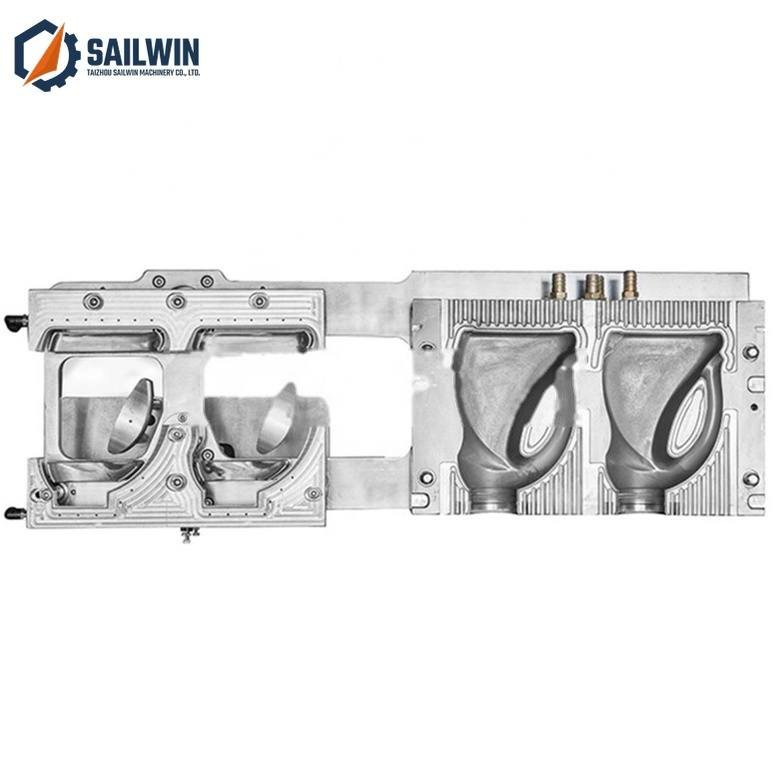
Figure 2: Precision CNC-milled pinch-off lands and flash relief cavities on Sailwin industrial extrusion blow mold.
3. Tooling Case Study: Chemical Jerrycan Molder Eliminates Drop Test Failures and Cuts Flash Scrap
Agrochemical Packager (Amman, Jordan) upgraded tooling specifications to Sailwin precision molds, cutting cycle times and eliminating structural part defects.
- Producing 5-liter UN-certified HDPE chemical jerrycans on an older 2-cavity P20 mold.
- Jerrycans consistently cracked along the bottom weld seam during 1.8-meter UN drop impact tests.
- Flash along the bottom seam required manual knife trimming by 2 operators, adding $18,000 in labor costs.
- Sailwin Mold re-engineered cavity bottom inserts with a 32-degree primary angle and 0.32mm land width.
- Integrated high-conductivity MoldMAX beryllium copper pinch-off blocks along the bottom weld line.
- Optimized flash pocket depth to 1.8mm with automated tail grabber grooves.
- UN drop test passed at 2.2 meters with liquid-filled containers at -18°C (zero seam rupture).
- Bottom flash detached cleanly in the automated deflashing station with zero secondary manual trimming.
- Molding cycle time dropped by 3.8 seconds due to 4x faster cooling in the beryllium copper pinch zone.
Data source: Sailwin Customer Field Case Log #JOR-PINCH-2025. Equipment: 5L EBM Jerrycan Mold.
3. Pinch-Off Steel Metallurgy & Wear Hardness Standards
Selecting tooling materials for maximum edge retention and heat extraction:
| Tooling Material | Hardness Level | Thermal Conductivity | Tooling Longevity & Application |
|---|---|---|---|
| P20 Pre-Hardened Tool Steel | HRC 30 – 34 | $29\text{ W}/(\text{m}\cdot\text{K})$ | Standard medium-volume HDPE/PP bottles (1M cycles) |
| S136 Mirror Stainless Steel | HRC 48 – 52 (Vacuum Hardened) | $20\text{ W}/(\text{m}\cdot\text{K})$ | Corrosive PVC/PVDC resins, medical containers |
| Aircraft Aluminum 7075-T6 | HB 150 (Moderate) | $130\text{ W}/(\text{m}\cdot\text{K})$ (Fast cooling) | Ultra-fast cycling; requires steel/copper pinch inserts |
| Beryllium Copper (CuBe MoldMAX) | HRC 38 – 42 | $135\text{ W}/(\text{m}\cdot\text{K})$ (Extreme cooling) | Mandatory for high-wear pinch-off edges, corners, and handles |
Frequently Asked Questions
Have specific mold requirements or technical drawings?
Connect directly with Sailwin’s tooling engineering department on WhatsApp for fast technical review.
4. Summary: High-Precision Mold Engineering
Achieving multi-million cycle tooling longevity and sub-10 second cycle times requires balancing mold metallurgy, high-speed conformal cooling channels, and micron-accurate cavity alignment. Sailwin Mold delivers turnkey blow molds, PET preform tooling, closure systems, and cap automation machinery backed by global commissioning support.
- Optimizing pinch-off land width (0.25mm–0.40mm) and dual angles ensures 100% airtight weld strength and easy flash trim.
- Integrating beryllium copper pinch inserts accelerates heat extraction and prevents parting line rounding over millions of cycles.
- Partner with Sailwin Mold for precision extrusion blow molds, jerrycan tooling, and modular pinch-off inserts.
SAILWIN MOLD · PRECISION TOOLING SOLUTIONS
Ready to Engineer Your High-Yield Plastic Mold?
Send us your container drawings (STEP/IGS/CAD) or physical samples. Our engineering department will perform DFM moldflow simulation, calculate cycle times, and prepare a comprehensive mold proposal within 24 hours.
Explore Precision Tooling & Machinery Solutions:
• extrusion blow molds – Industrial extrusion blow molds (EBM) collection.
• jerry can mold – 10L-30L chemical jerrycan extrusion blow molds.
• blow mold tooling – Automated deflashing bottle extrusion blow molds.
• drum mold – 200L L-ring chemical drum and IBC blow molds.
• Need custom tooling advice? Contact our tooling engineers for an individual container design evaluation.