
Updated: 2026 Machinery Guide · By Sailwin Automation Team
Cap Lining Machine Working Principle: Automatic Gasket Insertion & Wadding Guide
In commercial bottling and chemical packaging, a closure without an airtight hermetic seal is an invitation to costly product leakage, shelf-life oxidation, and catastrophic customer returns. While plastic injection molds produce dimensionally perfect cap shells, inserting protective foam or induction foil liners manually or with low-speed semi-automatic machines caps line throughput at under 2,000 pieces per hour, creating a severe operational bottleneck. Investing in an industrial cap lining machine is the defining step toward continuous, 10,000+ BPH packaging automation.
Sailwin engineers and builds turnkey rotary cap automation systems operating in over 30 countries across beverage, edible oil, pharmaceutical, and household chemical sectors. Our high-speed lining and wadding machines eliminate gasket jams, prevent double-feeding, and integrate 100% CCD camera inspection to deliver zero-defect sealed closures.
This technical guide details the engineering principles of automatic rotary wadders—comparing continuous roll punching against pre-cut wadding, detailing vacuum pick-and-place dynamics, and providing an RFQ checklist for choosing the optimal lining machinery.
Key Takeaways
- Roll-Fed Punching Cuts Raw Gasket Cost by 30%: Integrated coil punching mechanisms slice liners directly from rolls of EPE foam or induction foil, eliminating pre-cut supplier premiums and scrap shipping bulk.
- Rotary Multi-Station Speed Advantage: Continuous cam-driven rotary starwheels deliver reliable, jam-free output speeds from 8,000 to over 18,000 closures per hour without damaging delicate cap finishes.
- 100% Vision Zero-Defect Rejection: High-speed optical CCD cameras inspect every seated liner for inversion, wrinkles, or missing seals, triggering high-pressure pneumatic reject gates without slowing production.
Looking to automate bottle cap lining and gasket wadding?
Sailwin builds turnkey rotary lining machines tailored to your cap dimensions and foil specifications.
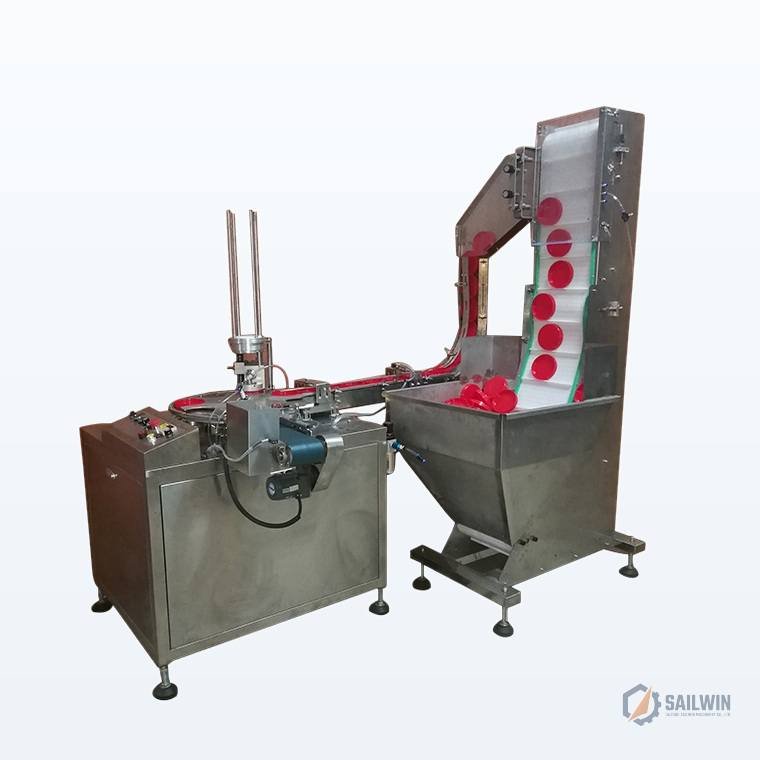
1. How Does a Cap Lining Machine Work? 4-Stage Automated Motion Flow
An automatic cap lining machine coordinates bulk cap orientation, roll coil unspooling, high-speed rotary die punching, pneumatic insertion, and optical vision inspection into a synchronized, continuous kinematic sequence.
Stage 1: Bulk Cap Orientation & Linear Infeed
Molded caps are loaded into a bulk floor hopper and elevated into a high-speed centrifugal or vibratory unscrambler. The orientation mechanism ensures 100% of caps travel face-down (open cavity facing upward) into the gravity feed track. Electronic sensors monitor track backpressure, automatically regulating elevator speed to prevent jamming.
Stage 2: Precision Coil Unspooling & High-Speed Die Punching
In roll-fed machines, a continuous strip of expanded polyethylene (EPE) or aluminum foil induction laminate is metered into a hardened punch die by precision servo pinch rollers. As each cap enters the rotary starwheel pocket, a hardened tool-steel punch shears a perfect disc and pushes it downward through a chamfered guide bushing into the cap floor.
Stage 3: Deep Seating & Friction Retaining
At the next rotary index station, a secondary pneumatic or cam-actuated pressing ram presses the gasket past the cap’s internal thread retention bead. The liner expands slightly into the undercut ring, locking itself permanently into place with zero adhesive required.
Stage 4: CCD Optical Vision Inspection & Pneumatic Rejection
Every single closure passes beneath an industrial CCD camera equipped with polarized LED ring lighting. The vision system inspects three criteria in under 15 milliseconds: (1) presence of liner, (2) correct foil orientation (metallic foil facing product vs backing facing cap), and (3) absence of wrinkles or edge crimping. Faulty caps are ejected into a reject bin via an air solenoid blast.
| Feature | Roll-Fed Punching Wadder | Pre-Cut Magazine Wadder |
|---|---|---|
| Raw Material Cost | 25% – 35% Lower (Buys bulk rolls) | Higher (Pays pre-cut supplier markup) |
| Production Speed | 8,000 – 18,000 caps/hour | 4,000 – 9,000 caps/hour |
| Changeover Flexibility | Requires punch die tool change (30 mins) | Rapid magazine change (10 mins) |
| Gasket Geometry | Circular / Standard Rings | Circular, Oval, Pull-tab, Complex Shapes |
Need custom cap lining tooling or high-speed wadding lines?
Send your closure drawings and liner specifications for an engineered machinery layout.
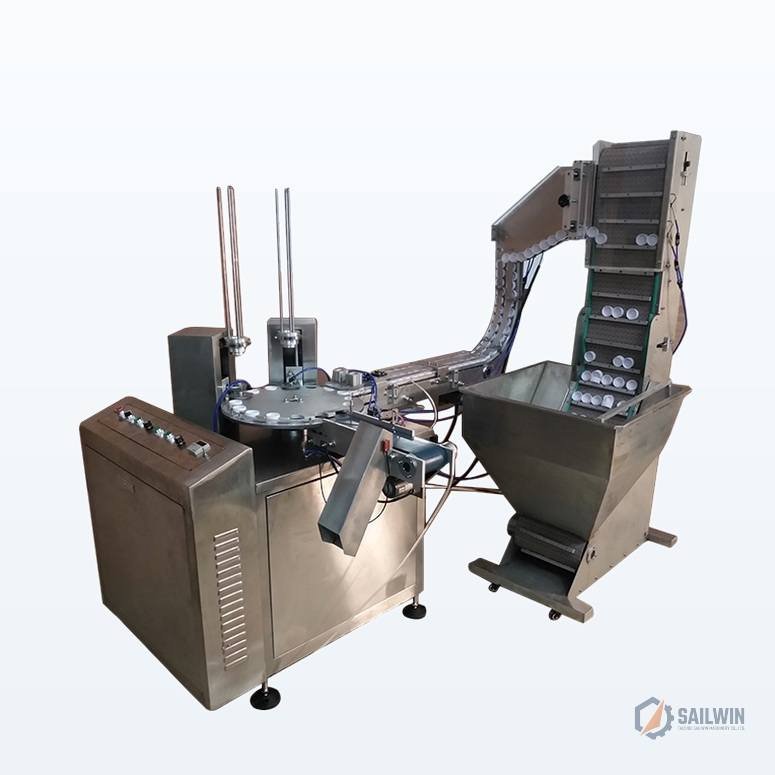
2. Upstream & Downstream Integration: Turnkey Closure Automation
A high-performance cap lining machine achieves its greatest operational return when linked seamlessly with injection molding machines and post-mold downstream automation cells.
In packaging lines, cap shells molded from our precision bottle cap injection mold systems flow through our cap slitting and folding machine to form the tamper-evident security band, before entering the cap lining and wadding machine. For multi-piece liquor closures, components are transferred into our rotary cap assembling machine to complete the finished packaging assembly.
3. Sailwin Case Study: Edible Oil Producer Cuts Gasket Defects to Zero
An edible oil processor in Egypt upgraded from manual wadding benches to a Sailwin rotary cap lining machine, saving $52,000 in annual labor while eliminating container transit leakage claims.
- Client: Commercial packaging brand producing 5L edible oil containers with 42mm pull-ring spout closures.
- Problem: 12 manual workers inserted aluminum foil induction liners; liner inversion rate was 3.8%, causing warehouse leakage.
- Throughput Limit: Maximum manual output was capped at 3,200 caps per hour across two 8-hour shifts.
- Turnkey Equipment: Installed Sailwin SW-LIN-100 high-speed rotary cap lining machine with custom 42mm starwheels.
- Integrated Punching: Converted from pre-cut discs to continuous roll-fed punching with servo foil tensioning.
- CCD Vision: Added dual-camera optical inspection checking liner presence and metallic foil top-side orientation.
- Labor Reduction: Replaced 12 manual operators with a single automated machine tender.
- Line Throughput: Increased output to 9,000 caps/hour (180% capacity boost).
- Quality Record: Zero customer leakage complaints over 14 months and 22,000,000 sealed containers.
Data source: Sailwin Customer Field Audit #LIN-2025-04. Equipment: SW-LIN-100 High-Speed Rotary Wadding Machine.
Ready to replace manual wadding with high-speed automation?
Sailwin provides free cap sample testing and video proof of machine trial runs before shipment.
4. Frequently Asked Questions: Cap Lining Machine Selection
Have unique closure dimensions or custom liner requirements?
Speak directly with Sailwin’s automation engineers on WhatsApp for quick sizing and quotation.
5. Summary: High-Yield Sealing Automation
Selecting the right cap lining machine eliminates production bottlenecks and safeguards your brand reputation against container leaks. Integrating continuous roll-fed die punching with high-resolution vision inspection provides the lowest per-part sealing cost and guarantees zero-defect deliveries.
- Choose roll-fed punching wadders for maximum cost savings on standard round caps.
- Always specify CCD optical camera inspection with pneumatic rejection for automated packaging lines.
- Partner with Sailwin Automation for synchronized cap molding, slitting, and lining turnkey systems.
SAILWIN AUTOMATION · CLOSURE WADDING EXCELLENCE
Ready to Automate Your Bottle Cap Sealing Lines?
Send us your cap samples and liner material specifications. Our packaging automation team will engineer a custom rotary lining layout with complete speed and pricing proposals within 24 hours.
Explore Closure Automation & Tooling Systems:
• cap lining and wadding machine – Turnkey high-speed gasket insertion systems.
• cap slitting and folding machine – Tamper-evident band slitting and folding machinery.
• rotary cap assembling machine – Multi-piece wine and spirits closure assembly lines.
• bottle cap injection mold – High-speed multi-cavity beverage closure molds.
• oil spout cap mold – Pull-ring and telescopic spout closure tooling.
• Need dedicated technical advice? Contact our automation team for customized machinery recommendations.