
Updated: 2026 Engineering Guide · By Sailwin Toolroom Division
PET Preform Injection Mold: Hot Runner System, Cycle Time & Cavity Alignment
In high-speed PET bottle conversion, preform quality directly dictates bottle blowing yields. An eccentricity deviation of just 0.10mm causes massive wall thickness variations during stretch blowing, triggering bottle blowouts, deformed base petals, and high reject rates on downstream filling lines. Furthermore, paired with an industrial pet preform injection molding machine, an inefficient cooling system or unbalanced hot runner manifold slows cycle times from an optimal 10 seconds down to 18 seconds, wiping out hundreds of thousands of dollars in annual production profits.
Sailwin engineers and builds world-class PET preform injection molds spanning 8 to 72 cavities for leading global water, carbonated soft drink, and edible oil bottlers. Utilizing vacuum-hardened S136 stainless steel, double-taper self-centering locks, and German heating elements, our tooling guarantees sub-0.06mm preform concentricity and industry-leading acetaldehyde (AA) levels under 2.0 ppm.
This technical manual explores the core engineering principles of high-cavity preform tooling—covering needle valve-gate balancing, double-taper locking physics, spiral cooling channel fluid dynamics, and preventive maintenance SOPs.
Key Takeaways
- Sub-0.06mm Preform Eccentricity Control: Precision double-taper alignment locks core pins to cavity inserts independently at each station, preventing core deflection during 800+ bar injection fill pressures.
- Ultra-Low Acetaldehyde (AA < 2.0 ppm): Streamlined, naturally balanced hot runner manifolds eliminate dead flow zones and reduce thermal residence time, protecting pure water taste profiles.
- Fast 9.5-Second Cooling Cycle: Combining core bubbler cooling tubes, annular cavity spiral water jackets, and beryllium copper neck inserts collapses thermal holding time by up to 40%.
Planning a new PET preform tooling project?
Send us your bottle drawings or preform specifications for a free preform weight and cavitation proposal.
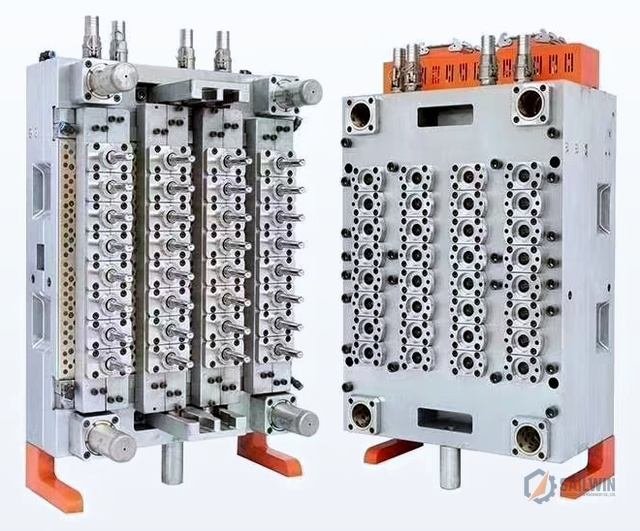
1. Precision Cavity Alignment: Double-Taper Locking Physics
Preform wall thickness uniformity determines bottle burst pressure and top-load strength. Sailwin’s double-taper self-locking mechanism guarantees that core pins remain perfectly centered during high-speed injection.
In standard injection molds, guide pillars maintain overall mold plate alignment. However, in long, slender preform tooling (where core aspect ratios exceed 5:1), minor platen deflection pushes the core off-center. Sailwin incorporates a two-stage precision taper lock on every individual cavity:
- Primary Neck Ring Taper: Precision 7-degree conical taper locking the split neck inserts tightly into the cavity block, sealing against parting line flash.
- Secondary Bottom Core Taper: Hardened guide bushings near the core base that absorb asymmetric melt flow forces during initial gate entry.
Need preform tooling with guaranteed sub-0.06mm wall concentricity?
Explore Sailwin’s valve-gate preform molds engineered for water, CSD, and wide-mouth containers.
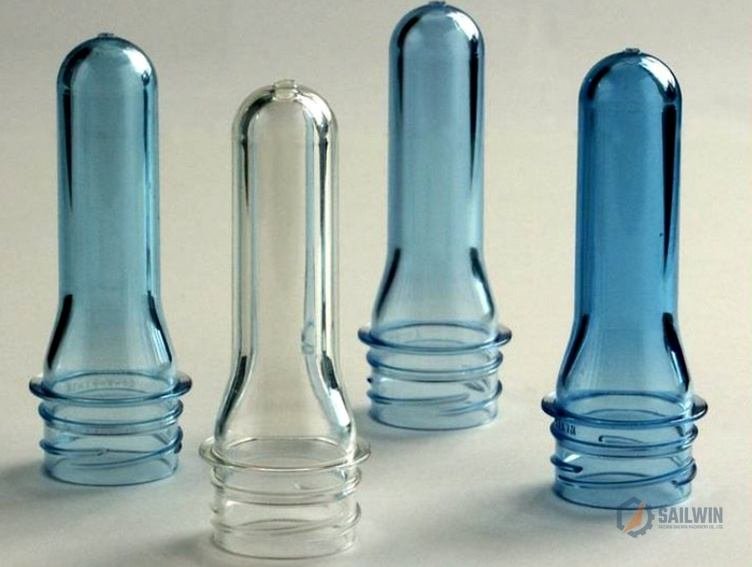
2. Hot Runner Manifold Hydraulics: Controlling AA and Gate Vestige
Acetaldehyde (AA) generation ruins mineral water flavor. High-end valve-gate preform molds require thermally balanced, mirror-polished circular hot runner manifolds with zero dead-corners.
Sailwin hot runner manifolds are gun-drilled, radiused at all elbow junctions, and flow-polished to an optical mirror finish. Each drop features an independently actuated pneumatic needle valve driven by high-temperature Viton seals. The shut-off needle cuts the molten resin flush against the cooled cavity insert, leaving a smooth gate vestige under 0.05mm. Compare this with cold runner costs in our plastic injection mold cost calculation guide.
3. Sailwin Case Study: 48-Cavity Preform Mold Cuts Cycle Time by 38%
A multinational water bottler in Saudi Arabia replaced an older 48-cavity preform mold with Sailwin’s high-speed valve-gate system, dropping cycle times from 15.8s to 9.8s while cutting scrap by 92%.
- Client: Bottling plant running a 350-ton injection machine producing 13.5g PCO1881 water preforms.
- Problem: Older mold had 15.8-second cycle time, severe neck ring flash, and preform eccentricity averaging 0.14mm.
- Downstream Consequence: Stretch blow molding machines suffered 2.8% bottle burst failure rates at 32-bar pressure.
- Tooling Upgrade: Commissioned Sailwin 48-cavity valve-gate preform mold built with S136 ESR stainless steel.
- Enhanced Cooling: Implemented dual-circuit spiral cavity cooling and beryllium copper neck split inserts.
- Concentricity Alignment: Deployed double-taper locking core assemblies with micro-adjustable centering rings.
- Cycle Time Slashed: Dropped from 15.8s down to 9.8s (38% throughput expansion).
- Concentricity Mastery: Preform wall thickness eccentricity held consistently beneath 0.045mm.
- Blowing Scrap Reduced: Downstream blow molding bottle failure rate dropped from 2.8% to 0.08%.
Data source: Sailwin Production Verification Report #PRF-2025-06. Tooling: SW-PRF-48VG 48-Cavity Valve-Gate Preform Mold.
Want to reduce your preform molding cycle times beneath 10 seconds?
Our tooling engineers will analyze your current preform drawings and calculate potential cycle savings.
4. Frequently Asked Questions: PET Preform Injection Molds
Looking to upgrade or refurbish your PET preform cold half?
Connect directly with Sailwin’s toolroom engineers on WhatsApp for immediate technical support.
5. Summary: Maximizing Preform Production Efficiency
High-cavity PET preform tooling requires precision engineering at every micron. By enforcing double-taper cavity alignment, balanced valve-gate hot runner hydraulics, and high-flow cooling, packaging converters achieve sub-10-second cycles with world-class bottle blowing consistency.
- Insist on S136 vacuum-hardened stainless steel for cores and cavities to guarantee 3,000,000+ cycle life.
- Maintain preform eccentricity below 0.06mm to prevent downstream stretch blowing defects.
- Partner with Sailwin for turnkey preform injection molds, cold half sets, and hot runner refurbishments.
SAILWIN TOOLING · PREFORM EXCELLENCE
Ready to Upgrade Your PET Preform Tooling?
Upload your preform prints or target bottle designs. Our engineering team will deliver a comprehensive mold cavitation proposal, cycle time simulation, and quotation within 24 hours.
Explore Precision Preform & Blow Tooling Systems:
• valve-gate preform molds – High-speed PET preform tooling from 16 to 72 cavities.
• pet blow molds – Aircraft aluminum 7075 and stainless blow molds.
• bottle cap injection mold – 1881 & 3025 beverage closure molds.
• plastic injection molds – Complete industrial tooling catalogue.
• Need dedicated technical advice? Contact our preform tooling team for custom mold engineering.

